Showing posts with label FDA regulation. Show all posts

Friday, December 6, 2024

A Deeper Dive into High School Vaping from the 2023 National Youth Tobacco Survey


The Centers for Disease Control and Prevention (CDC) reports that about 1.56 million U.S. high school students were current users (i.e., past 30 days) of e-cigarettes or other vaping products in 2023.  Although this number is substantially lower than at vaping’s peak in 2019 (here), it is still represented as a public health crisis by anti-tobacco crusaders.  This post takes a closer look at this number by examining other factors that were ignored by the CDC. 

The chart on the left breaks down the report’s 1.56 million vapers to calculate the actual number of exclusive, or “virgin” vapers.  I use a sequential subtraction method to isolate factors integral to vaping.  The chart reflects CDC weighting to estimate the numbers in detail, but in the following text, acknowledging real world facts, I’ll use abbreviated estimates.

According to the CDC, there were 15.8 million high schoolers in 2023, so about 9.9% of those were current vapers, that is, they had used the product at least once in the past 30 days.  About 204,000 of the 1.56 million current vapers were also current smokers, which leaves 1.36 million. 

Of these remaining vapers, 397,000 “ever” smoked a cigarette, even one puff, leaving 963,000.

After subtracting another 192,600 “ever” cigar smokers, we have 770,600 current vapers.

Finally, we have a factor that the CDC completely ignores, despite its coverage in the NYTS: “ever” vaping marijuana, tetrahydrocannabinol (THC) or cannabidiol (CBD).  There were 535,500 current vapers who had also vaped those marijuana-related products.

Now we have a reasonable estimate for virgin vapers, or those high schoolers who have not had any other exposure to similar tobacco or marijuana products.  The grand total is 235,021, representing only 1.5% of all high school students.

For further context, consider the frequency of vaping among virgin vapers: 63% had vaped only 1-9 days in the past month, 6% had vaped 10-19 days, and 31% had vaped 20-30 days.  While the latter group is at risk for being addicted to nicotine and vaping, these 73,092 frequent vapers represent just 4.7% of all high school vapers.  Even more importantly, they represent only 0.5% of all U.S. high school students.

Vaping among high school students is a legitimate concern, but vaping is not a new, isolated epidemic or crisis threatening to enslave a generation of teens to nicotine.  The NYTS demonstrates that vaping is connected with smoking cigarettes and cigars, and particularly with the use of THC/CBD. 

The FDA refuses to recognize that teen vapers also smoke and toke.  When the government obsesses over an imaginary “teen vaping epidemic” and denies its actual modest scope, it ignores the 480,000 adult tobacco smokers who die each year.


Thursday, August 31, 2023

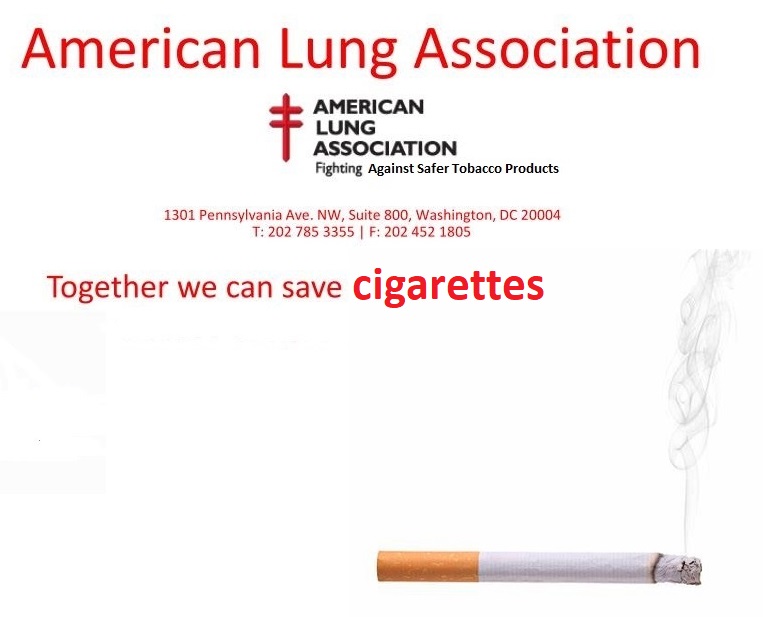
Say Goodbye to the American Lung Association


While the American Lung Association bills itself as “the leading organization working to save lives by improving lung health and preventing lung disease,” the group’s recent formal comment on the FDA Center for Tobacco Products’ Strategic Plan essentially endorses the greatest threat to lung health: cigarette manufacturers. Here is an excerpt from the group’s filing:

“Strategic Goal #4 - Improve Public Health by Enhancing Knowledge and Understanding of CTP Tobacco Product Regulation and the Risks Associated with Tobacco Product Use 

Remove language from the description for this goal that references informing adults about the relative risk of tobacco products” (emphasis in original)

“As mentioned in our comments above, the description for this goal included language ‘and to inform adults who smoke about the relative risks of tobacco products.’ The Lung Association strongly recommends this language be removed from the description.”

The ALA asks the FDA to remove any reference to the scientific fact that smoke-free tobacco products are vastly safer than cigarettes.  They are effectively urging the agency to withhold lifesaving information about safer products from smokers and their loved ones.

The nonprofit world’s poor record on cigarettes led me eight years ago to advise the public to say goodbye to the American Cancer Society.  Still, the American Lung Association in 2020 reported revenue of $106 million, with some 60% attributable to fundraising events, gifts and other contributions. 

It’s time for tobacco users and their families and friends to defund the cigarette-manufacturer-supporting American Lung Association.  Send your charitable contributions elsewhere. 


Wednesday, March 29, 2023

Finally, U.S. House of Representatives Holds FDA Tobacco Officials Accountable for Regulatory Missteps


This blog has long detailed the FDA Center for Tobacco Products’ (CTP) continuing campaign against vastly safer cigarette substitutes. 

Now House Committee on Oversight and Accountability Chairman James Comer (R-KY) has written FDA Commissioner Robert Califf demanding “documents and information regarding CTP’s activities to enable transparency and to ensure the CTP is performing required functions.”  This is a key paragraph:

“In conjunction, FDA must also clearly and accurately communicate information regarding the relative risk that products, to include ENDS [electronic nicotine delivery systems] and smokeless products, pose—and do not pose—to the adult nicotine product user population. Since 2005, the percentage of adult smokers in the United States has fallen from 20.9 percent to 12.5 percent. Nevertheless, there are still 30 million adult smokers in the United States, and nearly half a million Americans die from smoking related disease every year. This is a population that could benefit from accurate information and access to potentially safer FDA authorized products.”

FDA officials will likely deflect and assert that definitive relative risk information for ENDS and smokeless products is uncertain or inconclusive.  In fact, the relative risks for smokeless tobacco products like Swedish snus and American dip/chew products are roughly 2% of those for cigarettes, and 5% or less of those for vapor products. 

I hope Chairman Comer’s letter elicits other important information, such as why FDA officials didn’t publish clear guidelines for pre-market tobacco applications (PMTAs) prior to the deadline for PMTA submissions.  The agency perversely insisted that manufacturers of each new product first prove that it was “appropriate for protection of the public health,” without the benefit of any guidance.  That process resulted in millions of applications and gross review mismanagement by FDA staff.

The agency has until April 11 to respond to Chairman Comer’s demands.  That’s about two weeks, when some 18,400 more American smokers will die.