Showing posts with label FDA miscommunication. Show all posts

Tuesday, May 27, 2025

Commissioner Makary on High Schoolers Vaping: Half or Half a Percent?


In his Congressional testimony on May 22, FDA Commissioner Dr. Martin Makary said, “There are high schools in America now where kids are saying half of the kids are addicted to these vaping products.”

During the 2024 campaign, President Trump promised to save vaping.  Now that job falls to Dr. Makary, whose agency “oversees the safety of more than $3.9 trillion worth of food, tobacco, and medical products produced in the U.S. and abroad.”  With so much on his plate, he can be forgiven for not having all the facts yet on youth vaping.

Last December, I took a deep dive into vaping among American high schoolers, using the CDC’s 2023 National Youth Tobacco Survey (here), the latest available dataset.

My analysis demonstrated that some 73,092 of the nation’s 15.8 million high schoolers vaped frequently enough (20-30 days in past month) to be at risk for being addicted.  That represents only 0.5%, not 50%.

No one is comfortable with youth vaping, but Dr. Makary and his team should understand that vaping has contributed to the disappearance of smoking among American high schoolers, and the rate among young adults is similarly minimal.  This means that in 25 to 30 years, smoking-related diseases will nearly disappear, too.  It’s time for the FDA to focus on adult smokers over age 40, whose risk grows with each cigarette.  Going smoke-free will give them the chance for longer and healthier lives. 


Thursday, May 2, 2024

Call It Whatever You Want -- Tobacco Harm Reduction Saves Smokers’ Lives


The U.S. desperately needs tobacco harm reduction, starting with reducing the harm from the pronouncements of federal officials.  Case in point: FDA Commissioner Robert Califf’s April 11 tobacco testimony before the House Oversight Committee.

Dr. Califf made so many false statements that I penned a response for Real Clear Health. Following are some additional observations related to his testimony.

Readers know that I don’t tolerate doctors who claim they saw many people die from the ravages of tobacco, when those patients actually died from the smoke!  Similarly, I can’t let the federal official in charge of regulating tobacco get away with mislabeling it in the same fashion as the World Health Organization and the National Cancer Institute.

Dr. Califf wrongly claimed that harm reduction is an industry term.  My late colleague Dr. Philip Cole and I used that term in an article published by the American Council on Science and Health in 1995.  The Institute of Medicine, hardly a tobacco industry tool, titled a 2001 report, “Clearing the Smoke: Assessing the Science Base for Tobacco Harm Reduction (here).”

For 30 years, I’ve been saying, without challenge, “Nicotine, when consumed without the harmful constituents of cigarette smoke, is no more harmful than caffeine.”

Fifteen years ago Britain’s Royal College of Physicians, one of the world’s oldest and most prestigious medical societies, agreed with me, finding, “…that smokers smoke predominantly for nicotine, that nicotine itself is not especially hazardous, and that if nicotine could be provided in a form that is acceptable and effective as a cigarette substitute, millions of lives could be saved.”

Dr. Califf should stop supporting the cigarette industry by trashing vastly safer cigarette substitutes.  That's called tobacco harm escalation.


Thursday, August 31, 2023

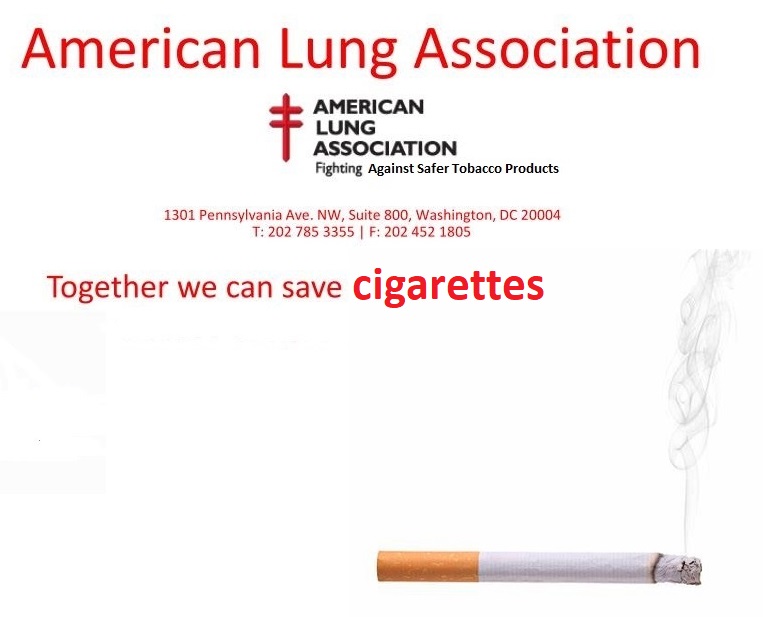
Say Goodbye to the American Lung Association


While the American Lung Association bills itself as “the leading organization working to save lives by improving lung health and preventing lung disease,” the group’s recent formal comment on the FDA Center for Tobacco Products’ Strategic Plan essentially endorses the greatest threat to lung health: cigarette manufacturers. Here is an excerpt from the group’s filing:

“Strategic Goal #4 - Improve Public Health by Enhancing Knowledge and Understanding of CTP Tobacco Product Regulation and the Risks Associated with Tobacco Product Use 

Remove language from the description for this goal that references informing adults about the relative risk of tobacco products” (emphasis in original)

“As mentioned in our comments above, the description for this goal included language ‘and to inform adults who smoke about the relative risks of tobacco products.’ The Lung Association strongly recommends this language be removed from the description.”

The ALA asks the FDA to remove any reference to the scientific fact that smoke-free tobacco products are vastly safer than cigarettes.  They are effectively urging the agency to withhold lifesaving information about safer products from smokers and their loved ones.

The nonprofit world’s poor record on cigarettes led me eight years ago to advise the public to say goodbye to the American Cancer Society.  Still, the American Lung Association in 2020 reported revenue of $106 million, with some 60% attributable to fundraising events, gifts and other contributions. 

It’s time for tobacco users and their families and friends to defund the cigarette-manufacturer-supporting American Lung Association.  Send your charitable contributions elsewhere.