Tuesday, February 1, 2022

FDA Blunders Again, Endorsing Reduced Nicotine Cigarettes Today…and 27 Years Ago


The Well News on January 25 published my commentary on the FDA’s recent regulatory blunder of approving a cigarette that provides all of the smoke but almost none of the nicotine of a traditional cigarette. 

Upon its publication, I received a number of critical emails suggesting that I had failed to properly research the issue.  In fact, those critics failed to do their due diligence on me.  To help them, here is another analysis I published on the subject – back in 1995.

A group of tobacco reformers, led by the Food and Drug Administration Commissioner, has a new regulatory strategy: reduce the amount of nicotine in cigarettes. The theory is that the nicotine concentration of cigarettes will be too low to allow nicotine addiction to be established in new smokers. In the meantime the strategy is intended to serve as a (mandatory) national withdrawal program for the nation’s current smokers.


The FDA commissioner has collaborators in this regulatory quest at the highest levels of academia and government. Two well known experts on nicotine addiction, Dr. Neal Benowitz from the University of California at San Francisco and Dr. Jack Henningfield from the National Institute on Drug Abuse, wrote an editorial in the New England Journal of Medicine essentially endorsing the fadeout plan. Although they admitted that “a threshold for nicotine addiction is a theoretical concept ...,” these researchers still postulated a safe concentration of nicotine in cigarettes that would prevent addiction in new smokers. To reach this level, the FDA would have to order a reduction in nicotine content from about eight milligrams per cigarette to about one-half of a milligram, representing a 94 percent reduction.


Although the fadeout idea has not been tested with regard to prevention, the plan has been studied for many years as a smoking cessation option. It is basically a drawn-out variation of a strategy called nicotine fading, in which the smoker’s exposure to nicotine is gradually reduced to very low levels. The concept was first introduced in 1979, and numerous trials, usually combining nicotine fading with other behavioral modifications, were conducted throughout the 1980’s.


In a recent review of 21 different quit-smoking strategies, nicotine fading came in with an unsurprising success rate — about 25 percent. Dr. Michael C. Fiore, director of the Center for Tobacco Research and Intervention at the University of Wisconsin, questioned the effectiveness of this strategy in helping current smokers quit. Of course if the FDA has its way, this program will not be optional. In other words, a large percentage of current smokers may not find this forced nicotine withdrawal a pleasant experience. What will they do?


As they did with low tar low nicotine cigarettes and those with filters, smokers will initially respond to the nicotine phase-out plan by smoking more often and more intensely. Benowitz and Henningfield acknowledged this problem in their editorial. They responded by saying that these smokers’ “short-term (ten-year) risk may be offset by the long-term benefit of a greater likelihood that they will quit smoking (as cigarettes become less satisfying) and by the enormous benefit of preventing nicotine addiction in future generations.”  In other words, they are sorry if your risks increase for ten years because you can't quit, but maybe you'll quit anyway and besides, maybe your children won't get hooked.


Another drawback to the fadeout plan is its potential to spawn another huge illicit drug problem. The FDA commissioner commented that “even if we don’t ban cigarettes, we could create a black market by removing the nicotine too quickly.” He seems to believe that the problem is avoidable simply by reducing the nicotine slowly. He is undaunted: “We need to withdraw it at just the right pace, letting the addiction fade as we reduce the nicotine.”


There are other fundamental problems with the strategy. For example, setting a threshold level of nicotine exposure below which it is not addictive is an extremely speculative tactic. This would imply that there may be a “safe” level of consumption for all addictions including alcohol, cocaine, and heroin.  A caffeine comparison serves us well here. Utilizing the same rationale concerning effect on body function (addictive potential) and intent (ability to manipulate levels), the FDA has ruled that caffeine is a food additive at concentrations up to 0.02 percent. This amounts to 72 milligrams of caffeine in a twelve-ounce soda. The FDA designates over-the-counter products containing caffeine (up to 200 milligrams per dose) as stimulants. Consistency is not a strong feature of the FDA’s caffeine policy, because a twelve-ounce serving of coffee can have as much as 400 milligrams of caffeine.


The important lesson from the caffeine analysis is that the FDA can draw on a precedent for every aspect of the nicotine fading strategy. The plan seems to be bolstered by an elegant scientific rationale, and it superficially appears to be a new and creative approach to the problem of nicotine addiction. However, that's where the real problem lies. Because antitobacco groups have passed judgement on nicotine addiction, they have focused all of their energy on eradicating tobacco. The nicotine fade is simply a thinly veiled disguise for tobacco prohibition.


That was my view, published 27 years ago in my clearly timeless book, For Smokers Only: How Smokeless Tobacco Can Save Your Life. Dr. David Kessler was FDA Commissioner at the time.

At the FDA, despite dramatic advances in tobacco science, virtually nothing has changed.


Monday, January 24, 2022

Facts About Safer Smoke-Free Products Are “Somewhere,” But Not at the FDA


I recently came upon the FDA website “Nicotine is Why Tobacco Products Are Addictive.”  The section “What Makes Tobacco Use Harmful” starts with partially truthful information: “Nicotine is what keeps people using tobacco products. However, it’s the thousands of chemicals contained in tobacco and tobacco smoke that make tobacco use so deadly.” [emphasis in original].

That’s not too bad, although agency officials know that the thousands of deadly chemicals are present only in smoke, not tobacco.  Then they get more specific. 

“Combustible products, or products that burn tobacco, are the most harmful. An example of a combustible product is cigarettes, which deliver more than 7,000 chemicals along with nicotine that makes it hard to quit.

“FDA-approved nicotine replacement therapies (NRTs), such as gums and lozenges, are the least harmful.”

Then it gets awful, as the guidance turns to noncombustible, or smoke-free tobacco products.

“Noncombustible products, such as heat-not-burn tobacco products, smokeless tobacco, and e-cigarettes, fall somewhere in between combustible products and NRTs.”

Somewhere?

The FDA has hundreds of scientists on staff and has funded research by thousands more at universities across America.  This federal agency is responsible for regulating the entire tobacco industry, and it sets precedents for tobacco regulation worldwide.  It claims to act only on the basis of hard science, yet it feigns ignorance about where the risks fall for smoke-free products.

This farcical position is undermined elsewhere on the webpage where the agency acknowledges that “many studies suggest e-cigarettes and noncombustible tobacco products may be less harmful than combustible cigarettes.” 

Those studies do more than suggest.  Britain’s Royal College of Physicians has stated for years that smoke-free products are at least 95% less hazardous than cigarettes – a fact that anti-tobacco zealots consistently ignore.  The FDA’s response is always “more research is needed,” though for this agency, there will never be enough.  Regulators know the facts, but they refuse to share them with smokers and their loved ones as smoker deaths continue to mount.


Thursday, January 13, 2022

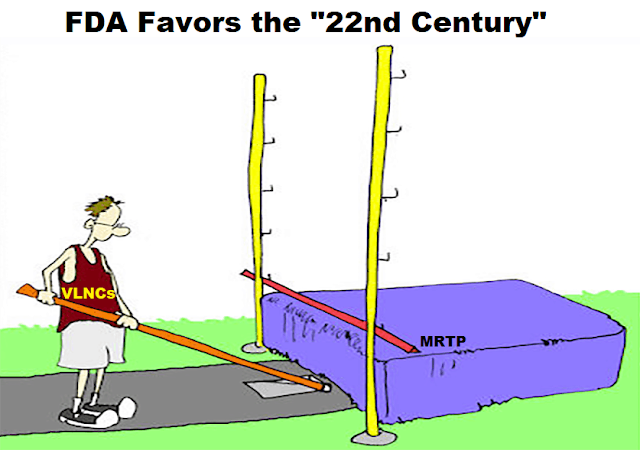
FDA Sets a “Very Low” Bar for Favored Tobacco Products


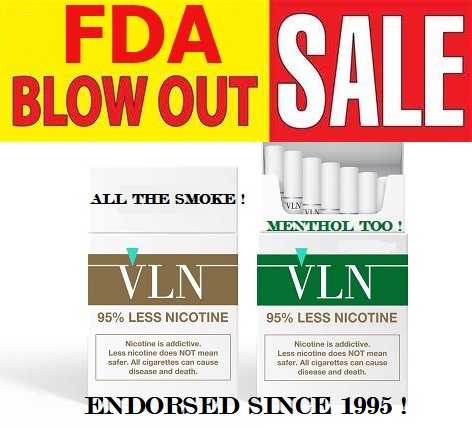
The U.S. Food and Drug Administration on December 23 announced it had “authorized the marketing of 22nd Century Group Inc.’s ‘VLN [Very Low Nicotine] King’ and ‘VLN Menthol King’ combusted, filtered cigarettes as modified risk tobacco products (MRTPs), which help reduce exposure to, and consumption of, nicotine for smokers who use them.  These are the first combusted cigarettes to be authorized as MRTPs…”

I do not understand how these VLN cigarettes will meet the agency’s tough MRTP standard, which requires that products “significantly reduce harm and the risk of tobacco-related disease to individual tobacco users and benefit the health of the population as a whole taking into account both users of tobacco products and persons who do not currently use tobacco products.”

Reducing nicotine will not reduce risk, as nicotine is not the cause of any smoking-related disease.  These products may reduce nicotine to trace levels, but their smoke will still contain thousands of toxins.  Where is the “benefit” to smokers, or to population health?

Mitch Zeller, director of FDA’s Center for Tobacco Products, supported the MRTP certification with unverified cessation claims for the products in the agency’s press release.  Here is what he said (bolding is mine): “data on these products show they can help addicted adult smokers transition away from highly addictive combusted cigarettes…these products authorized today, which contain less nicotine and are reasonably likely to reduce nicotine dependence, may help adult smokers. If adult smokers were less addicted to combusted cigarettes, they would likely smoke less and may be exposed to fewer harmful chemicals that cause tobacco-related disease and death.”

Clive Bates raises another major concern, which I share:

“One of the quite insidious aspects of FDA granting an MRTP order to the 22nd Century very low-nicotine cigarette (VLNC) is the extent to which FDA/NIH has financially supported the company’s application by buying its cigarettes and using independent research organisations and investigators in the United States to provide the evidence to support its case.”

After a search of the NIH funding database with the term “low nicotine cigarette” in the title or abstract, I found 698 projects totaling $286 million.  This does not mean that all of that money was invested in VLNCs, but at the very least it shows that the subject was a buzzword used by researchers to attract considerable federal financial support.

Clive Bates also notes:

“Any other tobacco or vape company would need to present extensive trials that it conducted itself and at its own expense, something that would be prohibitively expensive for most companies.  But not so for 22nd Century.

“FDA and NIH have been extraordinarily generous to [22nd Century]. These public bodies account for almost all of 22nd Century’s reduced-nicotine cigarette sales (there is no significant market for these products other than for research purposes). Not only that, through extensive funding of VLNC research, FDA and NIH have paid for the research base for 22nd Century to make a commercial application, via bridging, for a modified risk claim that is specific to the company and its products (it is not a general claim for the VLNC category). This MRTP order allows it to make actual and implied reduced risk claims for ongoing use of this product.”

The bottom line:  The FDA and NIH are advancing the government’s objective of “create[ing] a world free of tobacco [and nicotine] use” by using hundreds of millions of taxpayer dollars to fund research so that a private company’s cigarettes can be said to satisfy an FDA regulation requiring a benefit to smokers and the general population.

The VLNC MRTP was authorized by the FDA after 31 months of review, while the agency continues to crawl through MRTP reviews for Camel snus (58 months and counting) and Copenhagen moist snuff (46 months and counting).  Research dating back 28 years demonstrates that smokeless products are 98 percent less hazardous than cigarettes.

The FDA's decision to remove nicotine but keep the smoke is not only backwards, the regulator has doubled down on the smoke by failing to authorize the sale of thousands of vapor products already being used by millions of former smokers.  The result is regulatory purgatory at its deadliest.