Showing posts with label youth binge drinking. Show all posts

Tuesday, October 18, 2022

Washington Post Embraces the Flawed CDC Youth Vaping “Crisis” Narrative


The CDC’s latest report on youth vaping, based on the National Youth Tobacco Survey, showed that the vaping rate among U.S. high school students plummeted by half, from 28% in 2019, to 14% this year.  Still, the Washington Post editorial board on October 16 proclaimed the behavior “a public health crisis.”  Since their editorial is paywalled, I’ll give you the highlights.

The Post cited as evidence of a “public health crisis” the new findings released by the Food and Drug Administration and the CDC.  My readers know that these agencies don’t initially release unvarnished data; they issue spin on the data, keyed to supporting the crisis narrative.  The actual raw data will only be released after months of needless delay, when more thoughtful and balanced analysis will be ignored.

The editors focused on the news that “9.4 percent of middle and high schoolers — more than 2.5 million young people — reported using e-cigarettes in the month before taking the survey.”  Actually, from 2019 to 2022, the vaping rate among high schoolers was halved, a fact that should have lessened the editors’ fear of “lifelong health and behavioral risks associated with adolescent vaping.”  Additionally, the data show that youth smoking declined to record lows. 

While the number of youth vapers is still too high, it pales in comparison to the half-million adult smoking deaths that are recorded in the U.S. annually.  That’s the real crisis that is all but ignored by Washington elites.

The Post went on to repeat the vacuous claim that “nicotine… can harm adolescents’ cognitive development,” which would mean that a substantial number of today’s 89 million current and former adult smokers are brain damaged.  Kids should not vape, but the FDA knows there is no human research demonstrating that nicotine is detrimental to brain development or function.  Eschewing actual science, the agency is currently promoting a teen zombie social media campaign labeled “Real Costs.”

The influential Post is all-in on FDA action, urging it to “double down on getting illegal products off the shelves and streets.  Until most flavored products are taken off the market, teenagers will continue to consume them.”

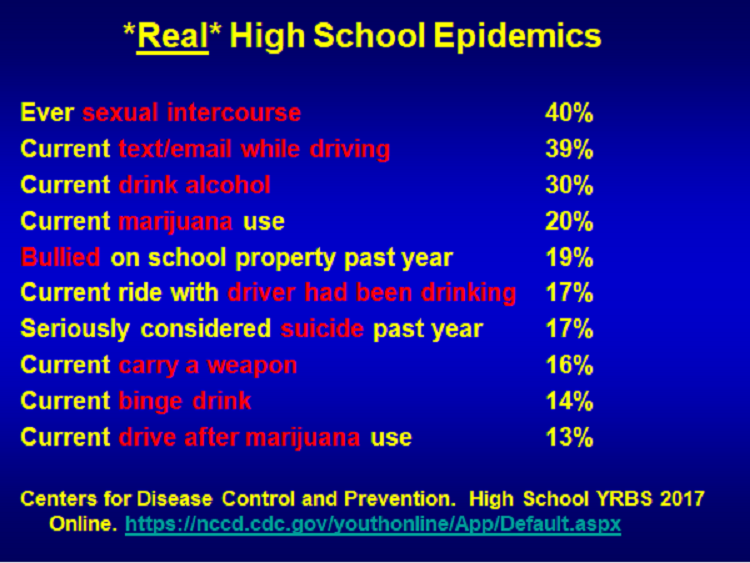
The problem is that high school students engage in a wide range of harmful behaviors, and vaping is low on the risk chart above.  Marijuana use, which was totally illegal for most of the past 30 years, persists at 20% among high schoolers.  The chart shows that many other high school behaviors, from driving while distracted or intoxicated, to drinking and binge drinking, to bullying and carrying a weapon, are far more dangerous and virtually ignored by federal authorities who choose to focus on a drug that is no more dangerous than caffeine.


Thursday, March 24, 2022

Sharp Decline in High School Vaping as Smoking Is Almost Eliminated


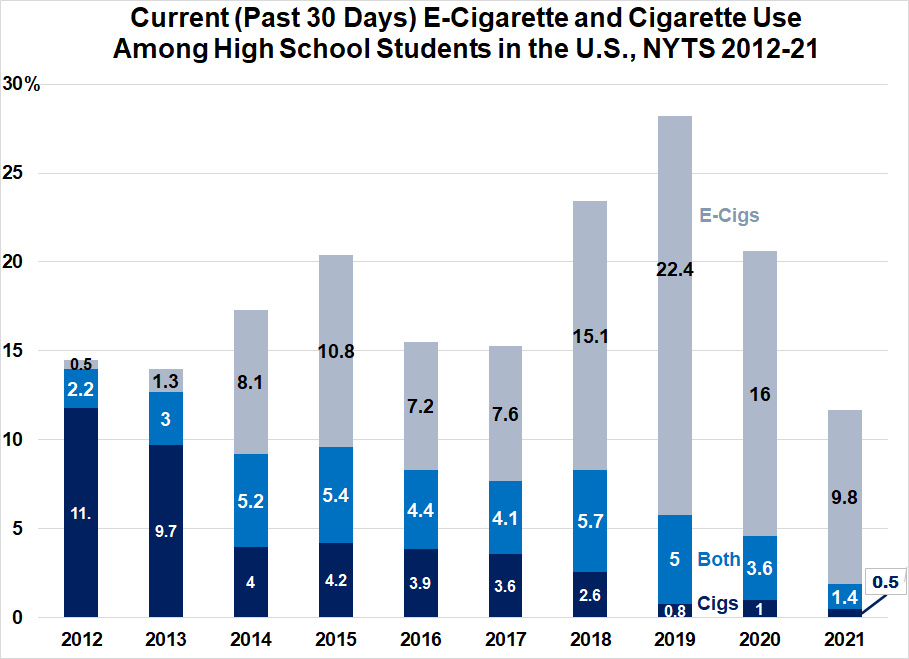
Last week, five and a half months after the CDC and FDA published selective information on 2021 teen vaping (generating frightening “epidemic” headlines in major news media), the CDC finally released data from the 2021 National Youth Tobacco Survey (NYTS).  I have confirmed the CDC finding that “11.3% of high school students (1.72 million) … reported current (past 30 day) e-cigarette use” (here).  However, the CDC failed to mention that this is a 58% reduction in high school vaping from peak prevalence of 27.5% (or 4.1 million) in 2019.  The survey also indicates that high school cigarette smoking declined to 1.9%.  


As indicated in the chart, this represents a profound alteration from 2018, when the vaping rate among high schoolers increased substantially.  The vaping rate rose again in 2019, but plummeted the next two years.  Importantly, during that period the smoking rate fell 77%, from 8.3% to 1.9%.  Tobacco prohibitionists’ claim that vaping would prove a gateway to smoking was without merit.  In fact, it is now clear that vaping helped cancel smoking.

Let’s explore some gaps in the government’s representation of the 1.72 million high school vapers.  First, about 519,000 of those vapers had also used other tobacco products, including cigarettes, cigars, pipes, hookah, smokeless tobacco, nicotine pouches and/or heat-not-burn (HNB) products.  With respect to HNB, the NYTS has some odd data points.  Roughly 316,000 high schoolers reported that they had ever used HNB, and 123,000 said they were current users.  That is simply impossible.  The only HNB sold in the United States was IQOS, but that product was taken off the market by a patent lawsuit.  Additionally, Philip Morris International implemented strict controls that limited teens’ ability to obtain the products.      

Of the 1.2 million “virgin” vapers with no other tobacco use, 732,000 used the products infrequently (19 days or fewer in the past month), and 467,000 vaped 20+ days.  This means that up to 3% of American high school students with no other tobacco use could have become addicted to vaping nicotine, a drug that is not associated with any smoking-related disease.  That number, while of concern, does not constitute an “epidemic,” even though anti-tobacco activists constantly use that term (here).

As I have noted previously, high school vapers are not just using tobacco/nicotine; they are  vaping marijuana at high rates as well. The next chart shows a large majority of high school vapers, regardless of frequency, have vaped marijuana. 


Government public health officials express moral outrage about youth nicotine use, but their concern ought to be directed at the real high school epidemics, evidenced by these statistics from the CDC:

39% text/email while driving

30% drink alcohol

20% use marijuana

17% ride with a driver who had been drinking

17% considered suicide in the past year

16% carry a weapon

14% binge drink

13% drive after marijuana use

Note to activists: Prioritize the activities putting teens at actual risk of injury and death.