Showing posts with label The Real Cost. Show all posts

Monday, March 17, 2025

The Real Cost of FDA’s “Real Cost” E-Cigarette Campaign


FDA staff just published a study in the American Journal of Preventive Medicine titled, “The Impact of ‘The Real Cost’ on E-cigarette Initiation among U.S. Youth.” 

The authors describe the campaign advertisements in the study’s appendix:

“Scary Enough.”  Metal monsters representing toxic metal inhalation

“Addiction Isn’t Pretty: Toilet.”  A teen reaches into a toilet to retrieve an e-cigarette thrown there by another teen, then takes a hit before walking out.

“Toxic Taxidermy.”  The interior of a taxidermy shop showing badly preserved animals who talk about formaldehyde in e-cigarettes.

“Don’t Pollute Yourself.”  A serene natural landscape where a pipeline starts dumping sludge, portraying toxic chemicals, into a lake, which is shaped like lungs.

The FDA authors used a nonpublic survey dataset to measure children’s exposure to the ads, and then they performed a “discrete-time survival analysis… to examine the impact of the exposure index on e-cigarette initiation at follow-up by using logistic regression models that controlled for the above-mentioned demographic and environmental variables.”

In other words, they estimated how many kids age 11-18 did not start using e-cigarettes because of the FDA campaign.  They said the ads prevented 444,252 children from starting to use e-cigarettes in 2023-2024, with a 95% confidence interval between 73,639 and 814,866.

Given that their estimate was more like a guesstimate, the authors should have rounded to the thousands or ten thousands. But, for this exercise, let’s assume the authors’ approach is valid, and that the ads prevented people from using e-cigarettes.  We can also assume that the effect that the authors claimed for 18-year-olds – basically adults – applies to the entire adult smoking population of nearly 27 million, per the 2023 NHIS.

Applying the authors’ analytics to the adult population, the FDA Real Cost Campaign prevented 654,477 adult smokers from switching to far less harmful, even life-saving, e-cigarettes.  The 95% confidence interval is 144,770 and 1,164,098.

I don’t believe the FDA ought to be evaluating its own campaign based on a secret dataset.  Between 2023 and 2024, teen vaping declined, so it’s easy for the FDA staff to claim that a concurrent FDA campaign was responsible.  Even worse, these FDA employees attest that they have “no financial disclosures” and that “The findings and conclusions in this report are those of the authors and do not necessarily represent the official position of the Food and Drug Administration.”  You gotta be kidding me.   


Tuesday, October 18, 2022

Washington Post Embraces the Flawed CDC Youth Vaping “Crisis” Narrative


The CDC’s latest report on youth vaping, based on the National Youth Tobacco Survey, showed that the vaping rate among U.S. high school students plummeted by half, from 28% in 2019, to 14% this year.  Still, the Washington Post editorial board on October 16 proclaimed the behavior “a public health crisis.”  Since their editorial is paywalled, I’ll give you the highlights.

The Post cited as evidence of a “public health crisis” the new findings released by the Food and Drug Administration and the CDC.  My readers know that these agencies don’t initially release unvarnished data; they issue spin on the data, keyed to supporting the crisis narrative.  The actual raw data will only be released after months of needless delay, when more thoughtful and balanced analysis will be ignored.

The editors focused on the news that “9.4 percent of middle and high schoolers — more than 2.5 million young people — reported using e-cigarettes in the month before taking the survey.”  Actually, from 2019 to 2022, the vaping rate among high schoolers was halved, a fact that should have lessened the editors’ fear of “lifelong health and behavioral risks associated with adolescent vaping.”  Additionally, the data show that youth smoking declined to record lows. 

While the number of youth vapers is still too high, it pales in comparison to the half-million adult smoking deaths that are recorded in the U.S. annually.  That’s the real crisis that is all but ignored by Washington elites.

The Post went on to repeat the vacuous claim that “nicotine… can harm adolescents’ cognitive development,” which would mean that a substantial number of today’s 89 million current and former adult smokers are brain damaged.  Kids should not vape, but the FDA knows there is no human research demonstrating that nicotine is detrimental to brain development or function.  Eschewing actual science, the agency is currently promoting a teen zombie social media campaign labeled “Real Costs.”

The influential Post is all-in on FDA action, urging it to “double down on getting illegal products off the shelves and streets.  Until most flavored products are taken off the market, teenagers will continue to consume them.”

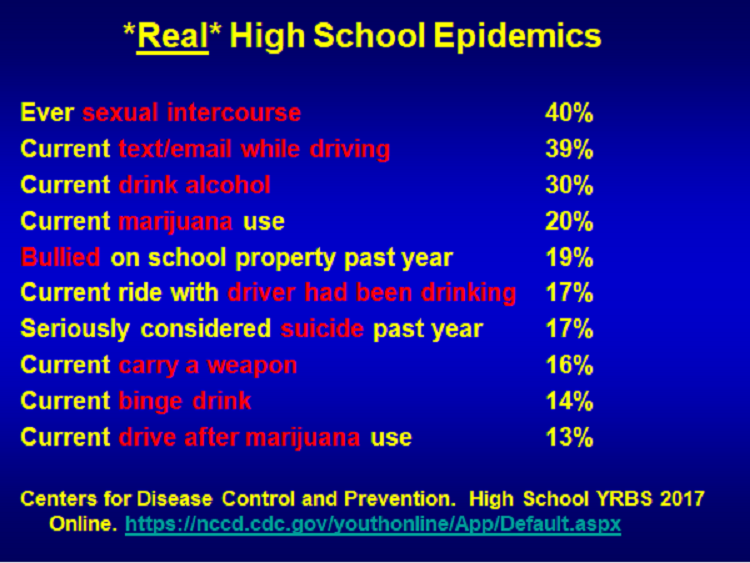
The problem is that high school students engage in a wide range of harmful behaviors, and vaping is low on the risk chart above.  Marijuana use, which was totally illegal for most of the past 30 years, persists at 20% among high schoolers.  The chart shows that many other high school behaviors, from driving while distracted or intoxicated, to drinking and binge drinking, to bullying and carrying a weapon, are far more dangerous and virtually ignored by federal authorities who choose to focus on a drug that is no more dangerous than caffeine.