Showing posts with label teen bullying. Show all posts

Tuesday, October 18, 2022

Washington Post Embraces the Flawed CDC Youth Vaping “Crisis” Narrative


The CDC’s latest report on youth vaping, based on the National Youth Tobacco Survey, showed that the vaping rate among U.S. high school students plummeted by half, from 28% in 2019, to 14% this year.  Still, the Washington Post editorial board on October 16 proclaimed the behavior “a public health crisis.”  Since their editorial is paywalled, I’ll give you the highlights.

The Post cited as evidence of a “public health crisis” the new findings released by the Food and Drug Administration and the CDC.  My readers know that these agencies don’t initially release unvarnished data; they issue spin on the data, keyed to supporting the crisis narrative.  The actual raw data will only be released after months of needless delay, when more thoughtful and balanced analysis will be ignored.

The editors focused on the news that “9.4 percent of middle and high schoolers — more than 2.5 million young people — reported using e-cigarettes in the month before taking the survey.”  Actually, from 2019 to 2022, the vaping rate among high schoolers was halved, a fact that should have lessened the editors’ fear of “lifelong health and behavioral risks associated with adolescent vaping.”  Additionally, the data show that youth smoking declined to record lows. 

While the number of youth vapers is still too high, it pales in comparison to the half-million adult smoking deaths that are recorded in the U.S. annually.  That’s the real crisis that is all but ignored by Washington elites.

The Post went on to repeat the vacuous claim that “nicotine… can harm adolescents’ cognitive development,” which would mean that a substantial number of today’s 89 million current and former adult smokers are brain damaged.  Kids should not vape, but the FDA knows there is no human research demonstrating that nicotine is detrimental to brain development or function.  Eschewing actual science, the agency is currently promoting a teen zombie social media campaign labeled “Real Costs.”

The influential Post is all-in on FDA action, urging it to “double down on getting illegal products off the shelves and streets.  Until most flavored products are taken off the market, teenagers will continue to consume them.”

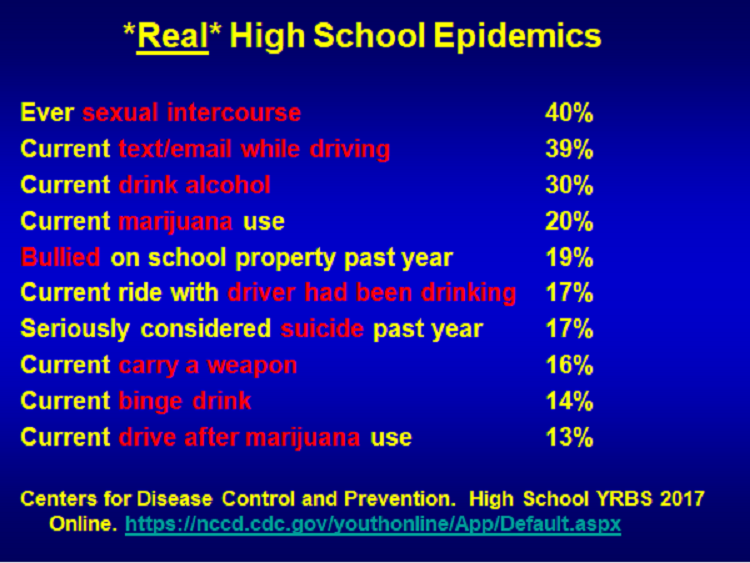
The problem is that high school students engage in a wide range of harmful behaviors, and vaping is low on the risk chart above.  Marijuana use, which was totally illegal for most of the past 30 years, persists at 20% among high schoolers.  The chart shows that many other high school behaviors, from driving while distracted or intoxicated, to drinking and binge drinking, to bullying and carrying a weapon, are far more dangerous and virtually ignored by federal authorities who choose to focus on a drug that is no more dangerous than caffeine.


Friday, December 28, 2018

Vaping Is Not the Real Health & Safety Threat in Kentucky High Schools


Foundation for a Healthy Kentucky (FHK) and Kentucky Youth Advocates (KYA) recently launched a campaign to discourage e-cigarette use by youth (here).  KYA executive director Dr. Terry Brooks predicted that “unless we as a commonwealth treat e-cigs as the health threat it is — in terms of now and in the future — then in 2038, Kentucky will still be the cancer capital of the nation.”  According to Ben Chandler, FHK chairman and CEO, “the fact that youth e-cig use is often a gateway to cigarette smoking makes immediate action imperative.”

Does evidence support the claim that e-cigarettes are a gateway to cigarettes? No.  Since the campaign cites the biennial Kentucky Youth Risk Behavior Survey, I have used KYRBS data to illustrate smoking and vaping among high school students in the Commonwealth from 2005 to 2017.

The chart at left shows that current (past-30-day) smoking declined from 26% in 2005, to 24% in 2011.  E-cigarettes were not widely available during that period.  In contrast, during the e-cigarette era (2011 to 2017), current smoking dropped from 24% to 14%.  The prevalence of current vaping, collected only in the latter two years, was 23% and 14% respectively. 

With the data showing show an unprecedented decline in smoking rates, there is no e-cigarette crisis among Kentucky high schoolers. 

KYA asserts that they “are laser-like in our efforts to…protect kids from abuse and neglect,…help kids grow up healthy and strong…” (here)  If that’s the case, they shouldn’t ignore behaviors that are far more dangerous than vaping.  For example, 27% of Kentucky high schoolers were current drinkers, 13% were current binge drinkers, and 16% were current marijuana users.  Additionally:


Prevalence (%) of Risky Behaviors Among Kentucky High School Students (KYRBS, 2017)


Past 30 Days


Rarely/never wore a seatbelt (as an occupant)9%
Rode with driver who had been drinking14%
Drove after drinking4%
Texted or emailed while driving35%
Carried a weapon (e.g. gun, knife, club)21%


Past 90 Days
Had sexual intercourse29%
..…and used condom, 51% of previous


Past Year


Involved in physical fight21%
Physically bullied on school property21%
Electronically bullied18%


Felt sad or hopeless29%
Considered suicide15%
Made suicide plan13%
Attempted suicide8%

Kentucky health organizations should stop obsessing about a mythical high school vaping crisis and focus instead on stopping other behaviors and activities that State data define as immediate health and safety threats.