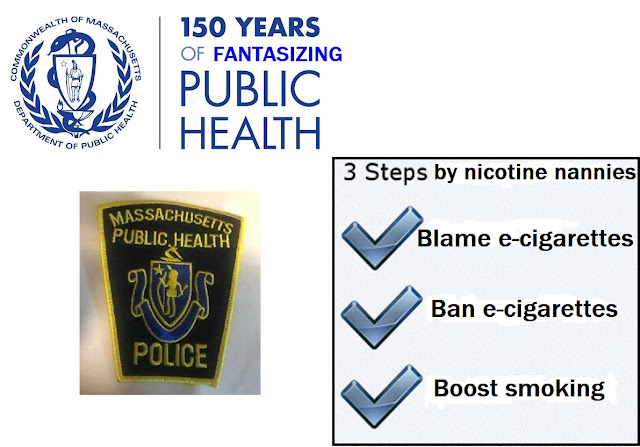
Officials at the Massachusetts Department of Public Health have published a report about the “implementation and evaluation of the public health emergency response to the 2019 outbreak of e-cigarette and vaping product use-associated lung injury [abbreviated EVALI]” in that state. The first author was Lindsay Kephart and the senior author was Dr. Monica Bharel, who served as Commissioner of the department from 2015 to 2021.
After the state received 38 EVALI case reports, Massachusetts Governor Charlie Baker on September 24, 2019 announced a “public health emergency response” which included a complete ban on “the sale or display of all vaping products…for 4 months.”
Kephart and colleagues celebrate the results in their report: “Massachusetts residents indicated high awareness of the EVALI outbreak and the corresponding public health response. Tobacco retailers were compliant with the temporary state prohibition on the sale of e-cigarettes. In response to reduced access to vaping products in stores, both adult and youth survey respondents reported reduced use, increased quit attempts, or complete e-cigarette cessation.”
What do these results indicate? First, tobacco retailers largely cooperated, despite the fact that by early September many, including me (here) and Boston University’s Dr. Michael Siegel (here), were noting that the lung injuries were unrelated to nicotine-based e-cigarettes and vaping products which had been used by tens of millions of consumers for a decade with no serious lung problems. Second, “high awareness” actually means the public had been seduced into believing, wrongly, that nicotine e-cigarettes and vapes caused EVALI.
The Kephart report didn’t mention a hugely significant response by vapers to the ban.
Table 3 provides information from a survey of 602 adult vapers, which asked: “did you switch to using or increase your use of any conventional tobacco products?” (A technical note: The total number of yes/no responses to that question in Table 3 is 609, which is greater than the 602 respondents. Kephart has not yet responded to my inquiry about this anomaly.)
In response, 231 vapers – nearly 40 percent -- said they switched or increased use of other products as a result of the ban. Since there is minimal smokeless tobacco use in Massachusetts, it is likely that the “other products” were cigarettes.
Converting 40 percent of smoke-free product users to smokers is an important and unfortunate result, for which ban architects must be held partially responsible. This was predictable and predicted. When will tobacco control activists ever own the foreseeable harmful consequences of their actions?


